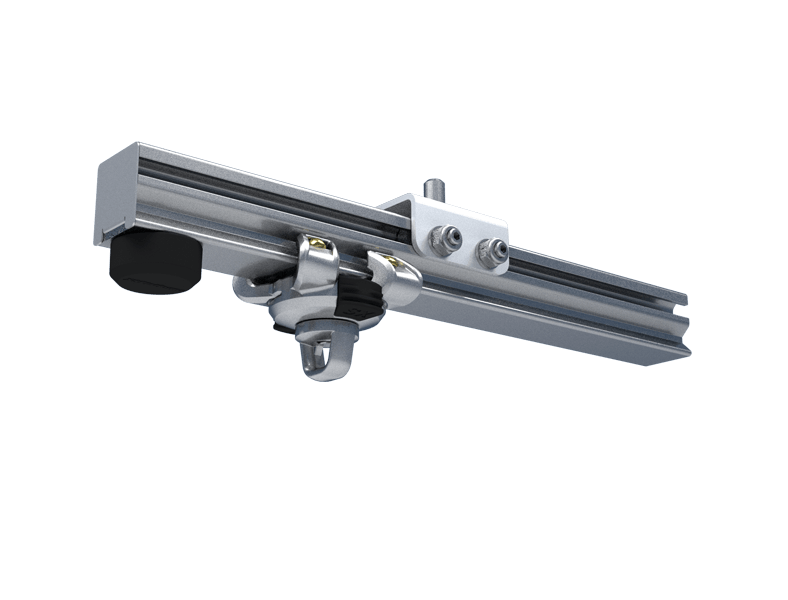
FALL PROTECTION WITH LIMITED FALL SPACE
Rigid rail fall protection systems are the right choice when fall clearance is limited. Unlike cable lifeline systems, a rigid rail virtually eliminates deflection during a fall – the worker is arrested in centimetres rather than metres. The XSRail by XSPlatforms is a permanent rigid rail fall protection system with up to 6 m bracket span, 6 simultaneous users, and 360° omnidirectional protection. It is certified to OSHA 1926.502, ANSI Z359.6, EN 795:2021 Type D, CSA Z259/16, and AS/NZS 1891.2 – tested by SATRA Technology Centre.
ABOUT FALL PROTECTION RAIL SYSTEMS
When collective protection (a guardrail) is not feasible, OSHA, EN, and ISO 45001 hierarchies of control require workers approaching within ~4 m (13 ft) of an unprotected edge to be tethered to a personal fall protection system. The two main options are a horizontal lifeline (steel cable) or a rigid rail system – and the right choice is driven primarily by available fall clearance below the working surface.
The XSRail system from XSPlatforms bends less in the event of a fall accident compared to a lifeline system; this results in a shorter fall distance. This makes the XSRail extremely suitable for projects and situations where limited fall height is available.

Designed and approved to meet the following standards:

What are fall protection rail systems?
An XSPlatforms rail system is a rigid horizontal steel beam mounted to a structure (roof, wall, ceiling, or overhead beam), combined with a runner that travels along the rail and connects the worker’s harness via a lanyard. Functionally it solves the same problem as a horizontal lifeline – continuous fall protection for lateral movement at height – but with a structural difference that matters when fall clearance is limited.
The advantage of a rigid rail over a cable lifeline is deflection. A steel cable behaves like a guitar string under load: it sags. The sag adds to fall distance, which means the system requires more clearance below the working surface. A rigid steel rail barely deflects (a few millimetres rather than centimetres), so the fall distance is dramatically shorter – typically 1 to 2 metres less than a comparable cable lifeline.
When paired with a self-retracting lanyard (SRL), an XSRail system arrests the user in fractions of a second after a slip. Use a rigid rail when: fall clearance is limited (overhead access, low-headroom plant rooms, indoor catwalks), the work area requires omnidirectional movement, or the location demands a low-profile architectural finish. Use a cable lifeline when: the span is long, fall clearance is ample, and cost-per-metre matters more than minimum fall distance.
The advantage of the rail system over a lifeline system is that rail has less deflection when a fall occurs. Because of this, the fall distance is shorter than with a lifeline system. So, for projects and situations where limited fall clearance is available, an XSRail system will be the best solution. When using an automatic fall arrest device, it arrests the user almost immediately in case of a fall, ensuring quick response and safety.
Rigid rail vs horizontal lifeline: which should you specify?
The choice between a rigid rail (XSRail) and a horizontal cable lifeline (XSLinked or LinkedPro) comes down to four factors:
- Fall clearance. A cable lifeline requires more clearance because of cable sag during arrest – typically 18 to 22 ft. A rigid rail cuts the required clearance significantly, often by 1 to 2 metres. If headroom below the working surface is the constraint, specify rigid rail.
- Work pattern. Rigid rail handles omnidirectional movement well (the worker can step off-axis without fouling the runner) and supports rope access and abseiling configurations. Cable lifeline favours single-direction lateral movement along an edge.
- Aesthetic / architectural constraints. Rigid rails are visually heavier than cables but can be specified in matching finishes; cable lifelines are visually lighter but the cable plus posts is harder to hide. Specify rigid rail for visible facades, premium retail, museums, and heritage work where a cable would be visually intrusive.
- Cost per linear metre. Cable lifelines are typically cheaper per metre because the cable + tensioner system uses lighter materials than a structural steel beam. For long open spans where clearance is ample, cable lifelines win on lifecycle cost. For short spans in low-clearance work, rigid rail is the right specification regardless of cost-per-metre.
XSRAIL APPLICATIONS
ON ROOF, WALL OR CEILING
Our fall protection rail systems are suitable for installation on various types of constructions, such as concrete and hollow-core slab structures. Additionally, the XSRail system is suitable for direct installation on (hollow) concrete walls and ceilings and on rigid steel structures such as I-beams. Regardless of the orientation of the XSRail, the system is exceptionally strong and can span distances of up to 6 meters. With more mounting points, you can create the right configuration to use the special XSRail Rope Access runner, making the XSRail the ideal fall protection solution for rope access techniques!

Rail systems for Roofs
When installed on roofs, the XSRail fall protection system is mounted on a series of XSBase plates. This unique roof anchor plate only requires a single fixation, ensuring a short installation time and minimizing the risk of roof leaks.

Rail systems for Walls
For concrete structures, the XSRail brackets can be installed directly on the surface using mechanical anchors and bolts. For steel structures, the brackets are similarly attached directly to the surface using bolt-and-nut connections.

Rail systems for overhead use
XSRail fall protection is mounted to rigid structures such as I-beams using bolt-and-nut connections. This makes the overhead system ideal for integration between grid panels.

Rail systems for Rope Access
With the use of more brackets placed with shorter distances, more sturdiness can be achieved. By doing this the possibility for abseiling is created. The orrientation of the rail can be on roof or directly installed on walls or overhead structures.
Need system advice for a roof or structure?
Send your request. We respond within 24 hours.
KEY FEATURES OF OUR
FALL PROTECTION RAIL SYSTEMS
When NOT to use a rigid rail fall protection system
A rigid rail is not the right answer in every situation. Consider an alternative when:
- The span is long and fall clearance is ample – a cable lifeline (XSLinked or LinkedPro) is significantly cheaper per linear metre at long spans.
- The work is single-point only – a fixed roof anchor point is cheaper and faster to install when a worker only needs to tie off in one location.
- The substrate cannot accept the rail load – older masonry, fragile sheet metal, or heavily corroded steel may need a custom-engineered solution rather than a stock rail mount.
- Collective fall protection is feasible – per OSHA, EN, and ISO 45001 hierarchies of control, guardrails (collective) rank above PFAS (personal). Where a roof edge can take a permanent guardrail, that is the preferred specification.
Certifications & Safety Standards
The XSRail from XSPlatforms is not only designed for optimal safety and ease of use but also complies with the strictest international standards in fall protection. The conformity of this rail system has been extensively tested and certified by SATRA Technology Centre Ltd. (United Kingdom) according to the following key standards:
The corrosion resistance of all XSPlatforms fall protection products is tested according to ISO 9227:2012. Furthermore the horizontal XSRail system has been designed to meet the requirements of the following standards:
With these certifications, our rail systems guarantee the highest level of protection and reliability, even in the most demanding environments. Users can work with confidence, knowing that the system meets internationally recognized fall protection standards.

XSRAIL PROJECTS FROM XSPLATFORMS PARTNERS
FAQ – ABOUT OUR FALL PROTECTION RAIL SYSTEMS

A rigid rail fall protection system is a permanent fall arrest installation in which a rigid steel beam (the ‘rail’) is mounted to a roof, wall, ceiling, or overhead structure, and a worker connects to it via a runner that travels along the rail. Unlike a cable lifeline, the rigid beam barely deflects under load, so the fall distance is dramatically shorter – typically by 1 to 2 metres – making rigid rails the right choice when fall clearance is limited. XSPlatforms supplies XSRail, a rigid horizontal rail system with up to 6 m span between supports and capacity for up to 6 simultaneous users.
Both systems give workers continuous fall protection while moving laterally at height, but they differ in deflection and required fall clearance. A horizontal lifeline uses a steel cable that flexes (sags) under fall load – typical sag plus lanyard plus worker height needs 18 to 22 ft of clearance below the working surface. A rigid rail system uses a steel beam that virtually eliminates that sag, cutting required clearance significantly. Choose a rigid rail for low-clearance work (overhead pipework, indoor catwalks, low-headroom plant rooms) and a lifeline for long open spans or roof edges where clearance is ample. XSPlatforms supplies both: XSRail (rigid) and XSLinked / LinkedPro (cable lifelines).
Rigid rail systems used for personal fall arrest in the U.S. must comply with OSHA 1926.502 (construction) and OSHA 1910 Subpart I (general industry), plus ANSI Z359.6 for design and ANSI Z359.1 for component performance. OSHA requires the system to limit arrest forces on a worker to 1,800 lb (8 kN), to be capable of supporting at least 5,000 lb per attached worker, and to be designed and installed under the supervision of a qualified person. The XSRail is tested and certified by SATRA Technology Centre to ANSI Z359.1:2017, ANSI Z359.6:2016, OSHA 1926.502, EN 795:2012 Type D, CSA Z259.16-15:2017, and AS/NZS 1891.2:2001 + 1891.3:2020.
An XSRail rigid rail system supports up to 6 simultaneous users along a single rail run. The exact maximum depends on the bracket spacing, the rail orientation (horizontal, wall-mounted, or overhead), and the substrate it is mounted to. For installations expecting frequent multi-user activity, the system can be configured with closer bracket spacing to handle higher dynamic load. Multi-user capacity is one of the principal advantages of rigid rail over single-cable lifeline systems.
The XSRail system supports a maximum bracket-to-bracket span of 6 metres (19.5 feet) under standard load conditions. Shorter spans (closer bracket spacing) are used when more rigidity is required – for example to support rope access operations, to handle higher user counts, or to accommodate a heavy-duty environment. Longer spans reduce installation cost by minimising the number of brackets and roof penetrations.
Tell us what you need. We will respond within 24 hours.